Sunday, 30 October 2011

I have been thinking further about the back of the "Warhorse" painting recently. When I made my previous painting of "Sophie" I made the picture out of her favourite poems. On the back of the support I also added her postcards of paintings she that she admires or has personal interest in. These postcards, although hidden when mounted on the wall give insight into who "Sophie" is and can help to tell a story about her. One of her passions is for the Pre-Raphaelite artists story and their work.
The Back of "Sophie" painting.
As part of my project for "Warhorse" I have begun to research my own family history. Through doing this I want tell the story of how so many people were effected by War and had relatives who were in the conflict. The stories and connections that we still have and feel today, nearly a hundred years later,are still strong. The way World War One was recorded and is remembered through photographs, film, poetry, art, letters strenghtens this connection.

I will be adding the  research into my family to the back of the painting to illustrate this. It will be a way of bringing me closer to my family history.

Tuesday, 25 October 2011

When working out how to create this painting and the portrait of 'Sophie' I looked at the work of Chuck Close. He uses a grid to create his large super realist portraits. Each of the squares in his grid is treated as a small painting which is a part of the whole portrait. I first came across his work when teaching my students at Northampton School For Girls.

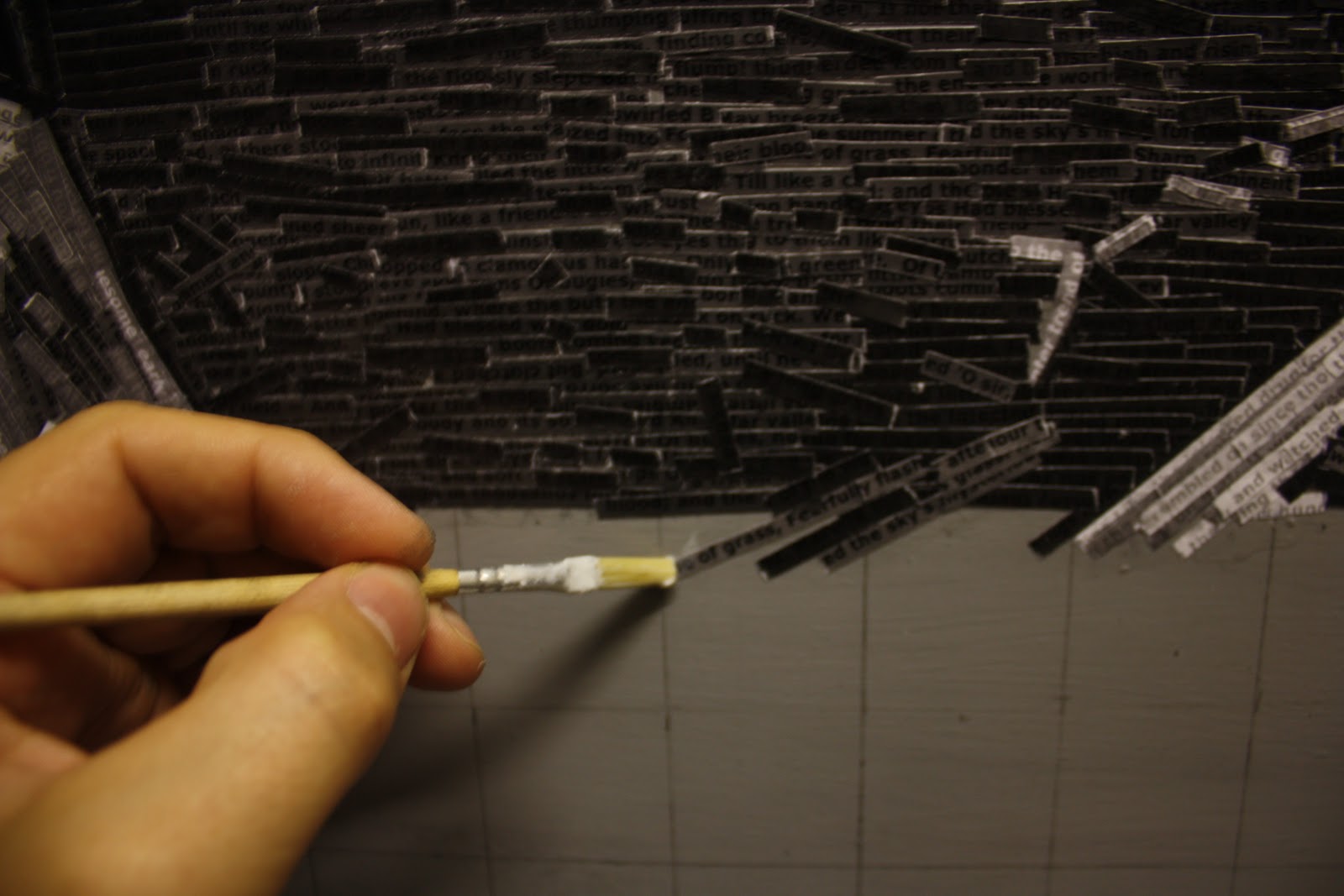
 I try to treat each square of my works as small painting and use a photograph as a guide when applying the tones. I cut out each line of text and layer it into the grid until I have achieved a very close likeness to the square. I also need to consider the style or look I want to create as well as the form of the object being depicted. This means the type needs to be applied in the direction which is most appropriate to the form.


Detail of a Self Portrait by Artist Chuck Close
 
Each strip of text is glued in to create the painting on the grid.

Wednesday, 19 October 2011


A short film which shows the detail of the painting so far and the text that makes up the picture.

Monday, 17 October 2011

The poetry of Wilfred Owen has been a strong influence to the work I am doing. His words as in many other poems speaks directly of the experience of  war and its horrors. As I listened to this tonight whilst painting it made me think of my own relatives who were lost. My grandmother lost two brothers. I think this is why World War One is so important to all of us - so many people know of relatives who were sent into the misery of this conflict. Even today the impact of this time has a profound effect on people.

Sunday, 16 October 2011

I have just seen the trailer for the film by Steven Spielberg. I was really pleased by the opening sequence of the trailer showing the horse running through the exploding shells and gun fire of "no mans land". 

Link to the trailer: http://www.imdb.com/video/imdb/vi3969097241/

It is just as I imagined the scene when I read it in the book. Great stuff! I hope the film really lives up to the book when I go and see it.

There is something very special about the relationship humans have with horses. Horses seem to have a great strength and free spirit as well as a sensitive nature that commands respect....

The idea that actors operate the actions of the horses in the play rienforces the close bonds and relationships that people have with these magnificent animals. It also emphasises the responsibility that people have for the horses wellbeing and lives.

An image from the stage production.

Wednesday, 12 October 2011

Thanks again for the positive responses to my latest posts about "Warhorse". The photograph which I am working from was created by collecting a series of images. Firstly the landscape or "no-mans land" was created using a collection of original photographs taken during the conflict. The horse was a contemporary photograph which I have distorted and added expression too. These were then montaged together on Photoshop. The whole image was then enlarged and printed full size to provide a tonal map of the whole painting.

Tuesday, 11 October 2011


This painting and style of work has inspired the work I am currently doing. I am particularly interested in the harsh contrast and almost metallic, angular machined look of the painting. The harsh, heavy Futurist work of the time representing the development of technology and changes in the way war was waged.


Nevinson, C.R.W. (1889-1946) - 1916 French Troops Resting (Imperial War Museum, London)